
New Brighton Resident Lookup Records
One name can surface in four different New Brighton sources with four different meanings. A property record names an owner. A court index names a party. Ramsey County's property tools link an owner or taxpayer to a parcel. They do not tell you who lives there now. A recorded document, by contrast, identifies the parties on the day it was filed. The filing happened at the recorder's office. Court and vital records place a person inside an event. Each result proves only the role it names. Before concluding anything about a New Brighton resident, set it beside an independent record.
| Record | What It Confirms | Where | Access |
|---|---|---|---|
| Tax and assessment card | Owner or taxpayer connection to a parcel, plus situs and mailing fields when displayed | Ramsey Beacon | Public assessment lead, not proof of title or current presence |
| Recorded document | Grantor, grantee, legal parcel, and recording-date connection | RecordEASE and the Recorder | Paid remote service or county counter and workstation access |
| Voter status | Status response for one official name, birth date, and address match | MNVotes | Private individual check; public lists have statutory limits |
| Court case | Party, case, court, filings, and publicly available docket material | MCRO | Remote view is unofficial and has access exclusions |
| Vital or historical index | Dated life event, family link, or earlier address trail | State vital, marriage, and historical indexes | Index access differs from copy eligibility and certification |
Start with the record that answers your actual question. A New Brighton address goes first to the parcel card. Then it goes to the deed behind it. A known court case searches best by case number. The party name works as a fallback. Marriage and death questions belong elsewhere. MOMS, MDH, and MNHS hold those, or the county office that keeps the record. Some names appear only in old volumes. Those searches belong in a library or an archive, not a current portal.
Define a New Brighton Resident
"Resident" is not one fixed status in a New Brighton records search. Every record answers a narrower question. A Beacon result may point to an owner, a taxpayer, or a mailing contact, and the mailing address can belong to a trust, a lender, or a representative. A deed names the people in a transfer. A directory edition places a household head at one address for one year. A court docket lists a party to a case. None of those labels alone proves a person lives at a New Brighton address today.
Keep the roles separate as you compare sources. Owner, taxpayer, recorded party, voter-status match, court party, heir, historical occupant: each label means something different. A mismatch can tell you more. When two records fight over a common name, a parcel number, a middle initial, a date, or an address copied exactly as the source spells it settles the question. Save the source date along with the result.
New Brighton Resident Lookup Trail
Start a current parcel connection in Ramsey Beacon by owner or by address. Compare the situs address with any mailing field. The situs address is the physical address of the property itself. Save RecordEASE for when a recorded instrument is needed. Electronic recording began in Ramsey County on April 24, 2014. Older Abstract and Torrens title records may still require a visit to the Property Records Resource Center. They are two separate land-title paths. That date is a format clue, nothing more. It does not mark the beginning of a New Brighton property's history.
For an historical connection, run the name against a dated directory, obituary, census, or deed. Label the result as historical. The New Brighton Directory Book is the better route into the local directory shelf. The North Suburban lead covers 1956 to 1958. The 1957 volume is reported missing. It also keeps nearby-suburb material from being mistaken for New Brighton coverage.
Verify a New Brighton Resident
Use two independent anchors before merging results for a common New Brighton name. A matching address pairs with a dated deed. A directory address can pair with a court party who shares the same distinctive middle name. Note the small details privately. Spelling variants, initials, prior surnames, hyphens, apostrophes, approximate age, associated people, and event dates all matter. A similar name in one index is not enough.
- Anchor the name to a New Brighton address or parcel through Beacon, while recording whether the result says owner, taxpayer, mailing contact, or situs address.
- Check RecordEASE for a document number, legal description, and recording date. If the online trail ends, use the Recorder's counter or Property Records Resource Center for older material.
- Search MCRO with the name and a sound-alike or trailing wildcard variant when appropriate, then narrow with Ramsey County, category, dates, and party role.
- Use a vital index only for the dated event it records. Obtain a certified copy from the actual custodian when an official copy is necessary and eligibility is met.
- Docket
- A chronological list of actions and filings in a court case, called the Register of Actions in MCRO.
- Index and image
- An index points to a record with names, dates, or identifiers. An image is the underlying document or page, which may have different access rules.
- Certified copy
- A copy issued by the court or record custodian as an official copy. A search screen or ordinary download is not the same thing.
- Parcel and situs address
- A parcel is the county's defined property unit. Its situs address is the physical location, which can differ from a mailing address.
- Grantor and grantee
- The grantor transfers an interest in a recorded document, and the grantee receives it.
Note: Recording dates and role labels let you test a match instead of accepting a single search result as proof.
Check New Brighton Court Records
Minnesota Court Records Online offers four search modes: Name, Case Number, Citation Number, and Attorney. A name search takes a last name at minimum. First and middle names, a date of birth or filing date, case category, status, and a county selector that includes Ramsey can all narrow the field. A trailing wildcard works after two characters. Sounds Like is a separate option and cannot be combined with a wildcard. Narrow the search before reading results.
For remote searches, MCRO supplies public case, hearing, monetary-judgment, and docket information. It is not the certified court record. Pending criminal, traffic, and petty-misdemeanor cases without a conviction do not return by defendant name in the remote search. Sealed, expunged, juvenile, restricted family, and protected victim material can also be unavailable. Use the Register of Actions, not the category alone. The disposition tells the real story. The MCRO search form shows the name and case filters available for a New Brighton court search.
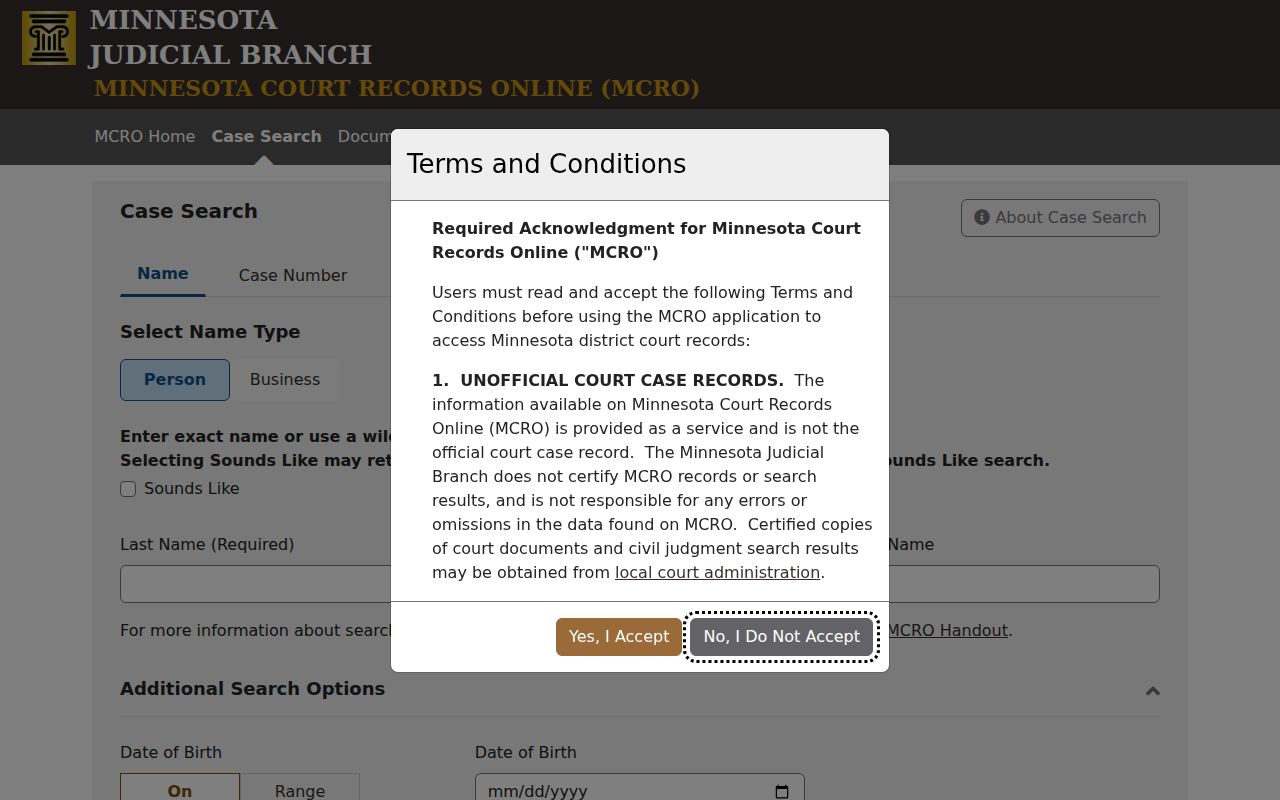
A name alone is not enough. Court results carry county, filing date, party role, attorney, and disposition, and those fields separate similar names in a New Brighton search. The State Law Library helps too. Courthouse public-access terminals and the library both give fuller electronic public access than remote MCRO. Court Administration handles certified documents by mail, phone, or in person, and the MNHS State Archives holds Ramsey civil files from 1858 to 1902 and criminal files from before 1953.
Read a New Brighton Court Result
Look past the name. A court result identifies a case, not a person, and it will not hand you a current New Brighton address or a final outcome. Match county, court location, filing date, and role. The inventory below lists the fields MCRO documents for public case results, subject to case-specific access restrictions.
| Field | What It Shows |
|---|---|
| Party and role | The indexed person or business and the part played in the case |
| Case number and court | The file identifier and Ramsey or other court location |
| Category and dates | Case type, filing date, and hearing dates when present |
| Register of Actions | Chronological filings, orders, judgments, and disposition detail |
| Documents and judgments | Public linked documents and monetary-judgment details where rules allow |
Start with the public case search. Pair it with the recorded deed trail. When a public result points to an estate, request the specific probate file or instrument. An obituary may suggest a relationship, but the estate record or recorded document is what verifies an heir before you call someone one.
Use New Brighton Voter Records
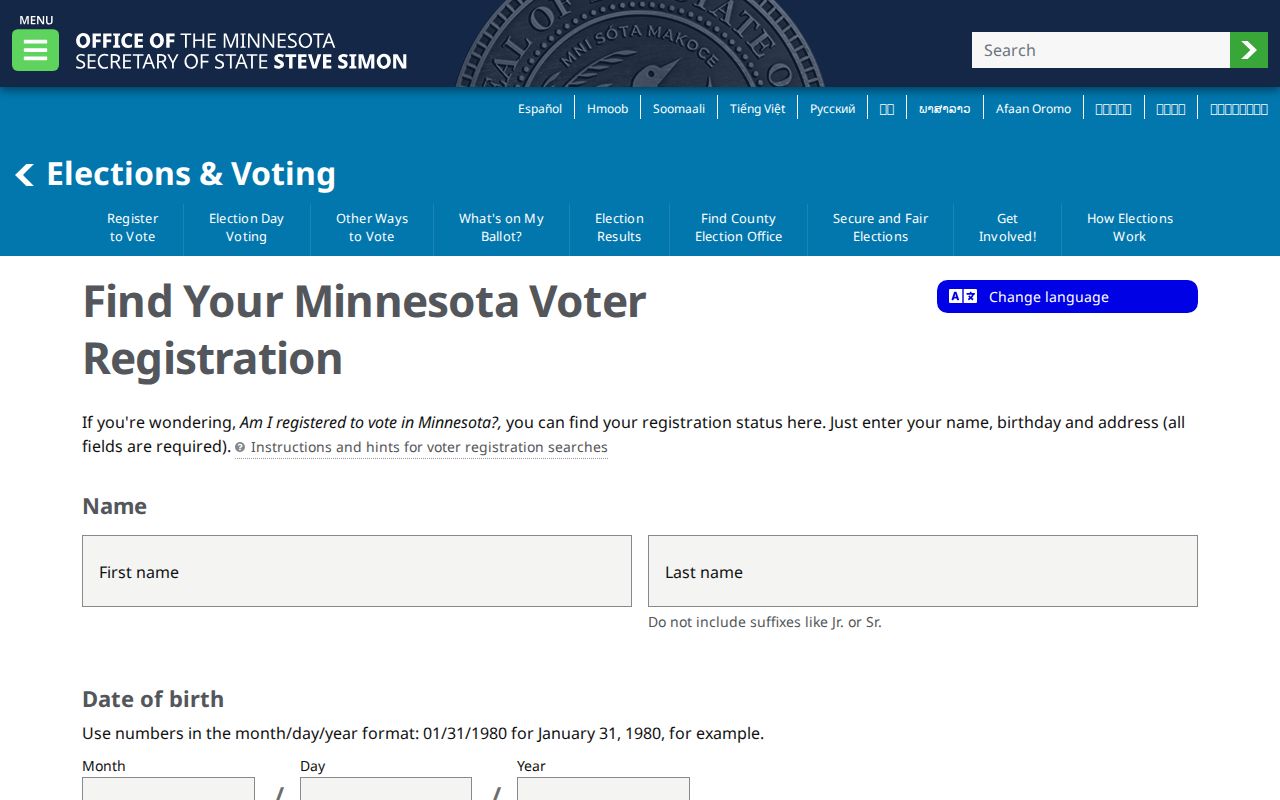
MNVotes checks one registration status at a time. It is not a public New Brighton residents directory. The form asks for first and last name, full date of birth, and either a ZIP route or a county, city or township, house number, street, and optional unit route. The state updates registration data nightly. Even so, a change can take time to process. A status reply proves nothing about ownership, current New Brighton presence, or another person's household.
Use the exact legal name. Keep the official address selectors private. The public information list runs under Minn. Stat. §201.091, which requires a written purpose and identification. Allowed uses are limited to elections, political activities, and law enforcement, with restrictions on searchable internet publication, sale, loan, and redistribution. Safe at Home participants have address protections that must not be defeated. MNVotes relies on the official name, birth-date, and address-match controls shown in this status-check image.
Keep the result to yourself. When an older voting record matters, note the election year and the map version, because precinct and district boundaries can shift over time.
Confirm New Brighton Vital Records
Vital records confirm a New Brighton life event or relationship. They do not supply a current address. MOMS, the public marriage index, points you to the county holding the record; Ramsey marriage records exist when the license was issued there. MDH keeps statewide birth records from 1900 and death records from 1908. Ramsey's own birth and death records start in 1850. Divorce decrees live with Ramsey District Court, not a universal MDH index.
Access is layered. MDH takes mail and fax orders, while county vital-records offices offer counter or mail channels. The state historical birth and death index covers deaths from 1904 to 2001 and births from 1900 to 1934. A separate state tool verifies deaths more narrowly. Libraries, historical societies, church registers, cemetery records, and newspapers can bridge earlier searches. An empty index result proves nothing. A record may still exist. Minnesota Department of Health Vital Records explains the distinct order and eligibility routes that apply once a search reaches a life event.
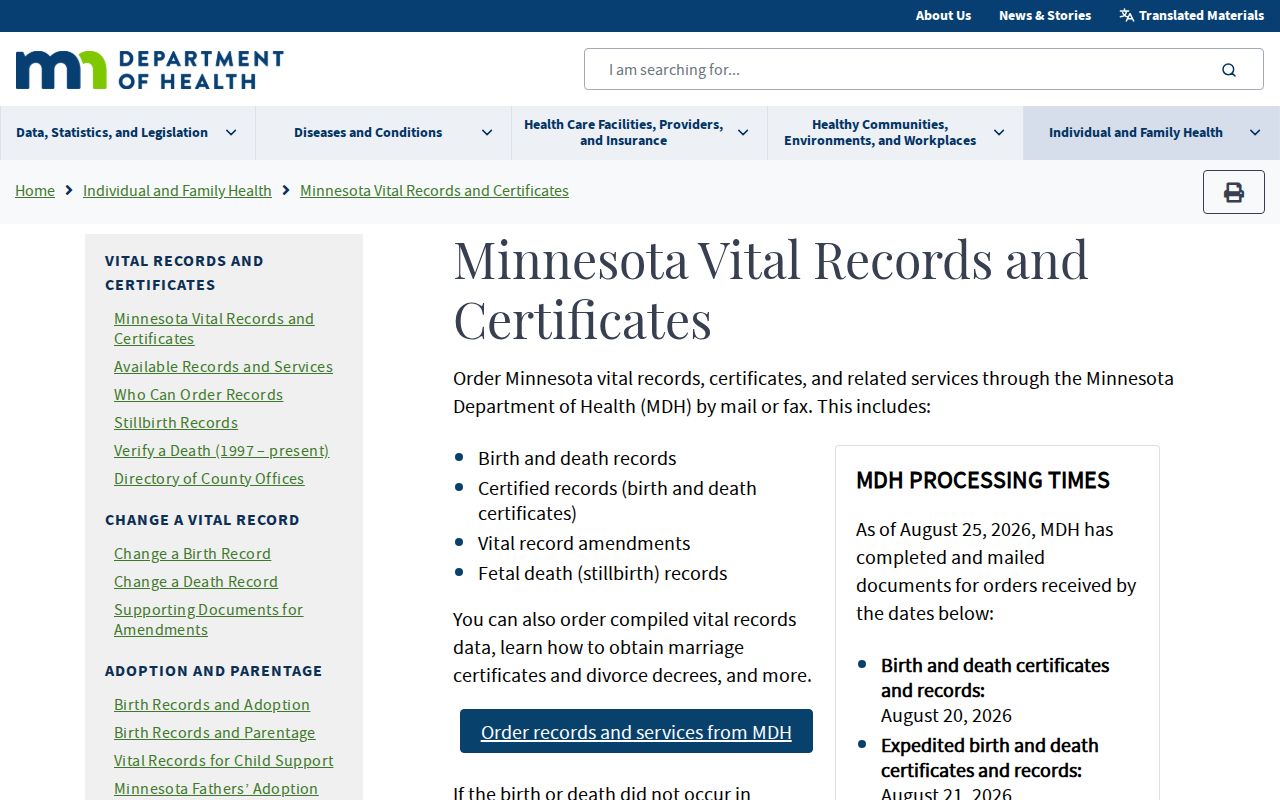
Certified birth and death requests require an eligible requester, identification, and an attestation before a notary or county staff witness. Noncertified death records are public. Birth classification and confidential parentage rules limit access instead. MDH, Ramsey Vital Records, and the court custodian decide who receives a copy.
New Brighton Resident History Leads
An old classmate, a rail-era family name, or a former address calls for dated material rather than guesswork. Start with the local keepers. The New Brighton Area Historical Society collects photographs, printed material, and artifacts for New Brighton, Arden Hills, and Mounds View. Ramsey County Library's New Brighton branch offers reference help and directory access, while the Ramsey County Historical Society and MNHS provide archival escalation.
Ask before you trust a title. Request the call number, year, and geographic run. Ask whether a name or address index exists. A title that sounds local proves little.
Place terms matter too. Records tied to a later New Brighton address may sit under Mounds View Township, village, or industrial names like New Brighton Exchange and Butchers Spur. History explains the mismatch. The 1887 survey, 1891 village incorporation, and 1974 city status explain why a historical name may not match a modern search, so treat every hit as a lead to test against dated records rather than merging neighboring-city results into a New Brighton identification.
Privacy Limits for New Brighton Records
Presumption is not permission. Minnesota government data are public only when no other law classifies them, under the Minnesota Government Data Practices Act and Minn. Stat. §13.03. New Brighton's policy draws the same line between public and private data.
Safe at Home addresses are protected. So is confidential birth information. Restricted voter identifiers, sealed or expunged court material, and nonpublic utility or motor-vehicle data stay closed too. Do not publish withheld information.
Errors happen. Preserve the document number, field, source date, and correction request, then contact the source custodian about the fix. Each office controls its own record. Minnesota's consumer privacy law, Minn. Stat. §§325M.10-.21, gives rights over covered private-sector data, but it cannot override government classifications or make a public portal a general-purpose resident list.
Lawful use. Use public records for a legitimate, personal purpose and respect every confidentiality limit. Using records to stalk, harass, intimidate, or harm someone is prohibited and may violate Minnesota law.
Request New Brighton Resident Records
A New Brighton record that is not online can still be requested under the MGDPA. The city takes requests by mail, email, fax, or an in-person visit to City Hall. Anything touching public safety can be routed to the New Brighton Public Safety Center. It can also go to records@newbrightonmn.gov. Say plainly whether you want to inspect the record or receive copies. Include the address, the name, the record type, and the date range. Inspection of public data costs nothing. Copies may carry charges. Private data requires identification or authorization.
Specificity matters at every counter in New Brighton. Court documents call for the case name and the exact document. Recorder material needs a document number, a recording date, or a legal description. Historical collections work best when you supply a title, a year, or a call number. Be ready to act, too. If you do not respond, pay, schedule, or pick up after the city sends its availability notice, the request may be treated as withdrawn. That can happen after five days.
Note: A narrow request helps the custodian locate public material. It also shields data the law classifies as private.